
$51.20
Add to Cart
Wonderful Chaenomeles Japonica Red Flowering Quince Flower Garden Plant
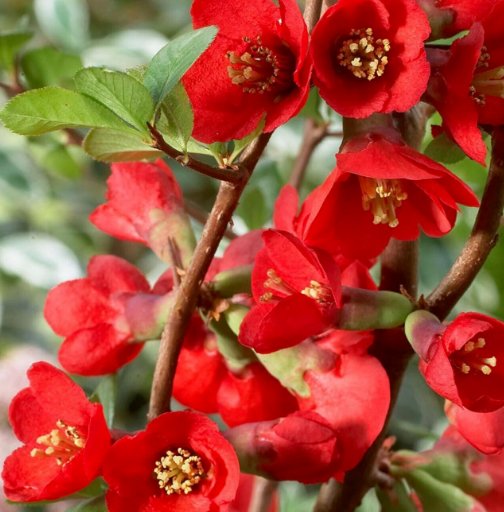


Chaenomeles japonica (Japanese Quince) Japanese Quince, Flowering Quince, Maule's Quince, Dwarf Quince, Japanese Flowering Quince Chaenomeles japonica (Japanese Quince) is a low-growing, deciduous shrub with abundant clusters of bright orange-scarlet flowers, up to 1.5 in. across (3-4 cm), adorned with creamy white stamens.
Popular for its showy early spring flowers, this species is a low-growing deciduous shrub that is easy to care for. It is also favored for use as a bonsai plant, particularly in Japan.
The fragrant flowers and fruit, known as quince, attract birds, bees, and butterflies. Quince fruit is too hard and tart to be eaten raw, but is used to make jellies and preserves. In some parts of the world, quince is bletted (left to near rot) to make it softer and sweeter, and therefore edible.
Preferred USDA Hardiness Zones
Japanese quince is recommended for USDA hardiness zones 5 through 9.
Size and Shape
This shrub typically grows 2 to 3 feet in height and will spread to as much as 6 feet across. Its growth is dense and bushy.
Sun Exposure
Japanese quince will tolerate partial shade but will produce the most blossoms if planted in full sun.
Foliage, Flowers, and Fruit
The Japanese quince produces tangled thorny branches that are gray-brown. The leaves are dark green and coarsely-toothed, growing 1 to 2 inches in length. In winter, the leaves wither and usually fall off, although dried leaves may cling to the branches throughout the winter.
In March, the blossoms burst forth from buds that have developed on the bare branches during the late winter. The flowers are composed of five petals with white stamens in the center. They are typically a brilliant orange-red but may be pink or even creamy white. It is not until after blossoming that new leaves are produced.
In the autumn, the tree bears small apple-shaped fruits. The fruit is green to yellow and very hard, making it difficult to eat in the raw state. Fruit that has been cooked or softened by a frost can be eaten. More often, the fruit is used to create jelly, preserves, or combined with apples to make a pie.
Design Tips
Japanese quince is well suited for use as a low hedge or barrier plant. It can be trained to grow on a trellis or espaliered, which is grown along a wall or frame. Garden borders or specimen planting are another possible use for this species.
In winter, branches with formed flower buds may be cut and taken indoors to force blooming. This makes for an attractive winter floral arrangement.
Growing Tips
One of the reasons for the popularity of Japanese quince is its ease of care. It tolerates a wide range of conditions and is drought resistant. During dry periods, it should be watered regularly, taking care to avoid over-watering. Like any shrub, Japanese quince will benefit from an annual all-purpose fertilizer, but it is not required.
Ships to the US mainland only.
No shipping to PR.
PACKAGE
1 x Starter Plant
Popular for its showy early spring flowers, this species is a low-growing deciduous shrub that is easy to care for. It is also favored for use as a bonsai plant, particularly in Japan.
The fragrant flowers and fruit, known as quince, attract birds, bees, and butterflies. Quince fruit is too hard and tart to be eaten raw, but is used to make jellies and preserves. In some parts of the world, quince is bletted (left to near rot) to make it softer and sweeter, and therefore edible.
Preferred USDA Hardiness Zones
Japanese quince is recommended for USDA hardiness zones 5 through 9.
Size and Shape
This shrub typically grows 2 to 3 feet in height and will spread to as much as 6 feet across. Its growth is dense and bushy.
Sun Exposure
Japanese quince will tolerate partial shade but will produce the most blossoms if planted in full sun.
Foliage, Flowers, and Fruit
The Japanese quince produces tangled thorny branches that are gray-brown. The leaves are dark green and coarsely-toothed, growing 1 to 2 inches in length. In winter, the leaves wither and usually fall off, although dried leaves may cling to the branches throughout the winter.
In March, the blossoms burst forth from buds that have developed on the bare branches during the late winter. The flowers are composed of five petals with white stamens in the center. They are typically a brilliant orange-red but may be pink or even creamy white. It is not until after blossoming that new leaves are produced.
In the autumn, the tree bears small apple-shaped fruits. The fruit is green to yellow and very hard, making it difficult to eat in the raw state. Fruit that has been cooked or softened by a frost can be eaten. More often, the fruit is used to create jelly, preserves, or combined with apples to make a pie.
Design Tips
Japanese quince is well suited for use as a low hedge or barrier plant. It can be trained to grow on a trellis or espaliered, which is grown along a wall or frame. Garden borders or specimen planting are another possible use for this species.
In winter, branches with formed flower buds may be cut and taken indoors to force blooming. This makes for an attractive winter floral arrangement.
Growing Tips
One of the reasons for the popularity of Japanese quince is its ease of care. It tolerates a wide range of conditions and is drought resistant. During dry periods, it should be watered regularly, taking care to avoid over-watering. Like any shrub, Japanese quince will benefit from an annual all-purpose fertilizer, but it is not required.
Ships to the US mainland only.
No shipping to PR.
PACKAGE
1 x Starter Plant


 ID, Maluku